
ICH Q3D is not a future development — it has been in force since 2018.
A technically demanding audience, with GMP qualification requirements as central as the analytical chemistry itself.
The most significant change to elemental impurity testing in decades.
ICH Q3D (Guideline for Elemental Impurities) and its pharmacopoeial implementations — USP <232> (Elemental Impurities — Limits) and USP <233> (Elemental Impurities — Procedures) — replaced the century-old wet-chemistry heavy metals test (USP <231>) with instrumental determination of 24 specified elements at defined permitted daily exposure limits, using validated procedures. USP <233> effectively requires ICP-OES or ICP-MS, and specifies closed-vessel microwave digestion for samples that are not readily soluble — in force internationally since 2018 and being implemented by SAHPRA in South Africa.
Where microwave chemistry sits across the pharma workflow.
Elemental impurity testing
ICH Q3D / USP <232>/<233> — required for all registered medicines. Digestion by MARS 6 or BLADE, followed by ICP-OES or ICP-MS.
Residue & loss on ignition
USP <281> and <733> — routine QC on APIs, excipients and finished products. Phoenix BLACK with sulfated ashing.
Sulfated ash
USP <281> — Phoenix BLACK Sulfated Ashing configuration.
Elemental contaminants in supplements
USP <2232> — similar methodology to pharmaceutical testing. See our Nutraceuticals page.
Microwave synthesis
Medicinal chemistry and API route development — rapid, clean reaction conditions with Discover 2.0.
Peptide APIs
Liberty PRO cGMP synthesiser for GLP-1 and other peptide therapeutics.
Protein digestion
Biopharmaceutical characterisation — digestion workflows including Discover Proteomics.
Extractables & leachables
EDGE solvent extraction from packaging materials.
From research-scale route scouting to cGMP peptide manufacture.
The Liberty 2.0 family covers peptide API synthesis from research through cGMP scale, including GLP-1 and other peptide therapeutics. CEM's Liberty PRO is positioned as the cGMP synthesiser for this workflow, with Prodigy 2.0 available for peptide purification.
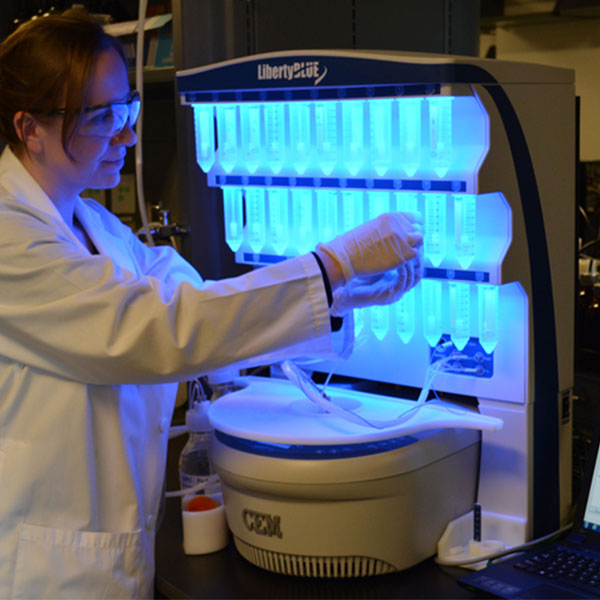
Instrument qualification is as central to pharma buyers as the chemistry.
South African pharmaceutical manufacturing is regulated by SAHPRA under GMP standards broadly aligned to WHO and ICH guidelines. GMP environments require documented Installation, Operational and Performance Qualification (IQ/OQ/PQ), calibration certificates traceable to NMISA, software validation to 21 CFR Part 11 / EU Annex 11 for electronic records, and documented change control. CEM's Liberty 2.0 software is explicitly 21 CFR Part 11 compliant.
The pharmaceutical & biotechnology workflow.
| Application | Product |
|---|---|
| Elemental impurity digestion (ICH Q3D / USP <233>) | MARS 6, MARSXpress 2.0, BLADE |
| Residue on ignition / LOI | Phoenix BLACK |
| Sulfated ash (USP <281>, <733>) | Phoenix BLACK — Sulfated Ashing |
| Peptide API synthesis (research) | Liberty Blue 2.0, Liberty PRIME 2.0 |
| Peptide API synthesis (cGMP) | Liberty PRO |
| Peptide purification | Prodigy 2.0 |
| Microwave synthesis (API route scouting) | Discover 2.0 |
| Protein digestion (proteomics / biocharacterisation) | Discover Proteomics, DigestPro |
| Peptide synthesis, entry-level / manual research scale | Discover Bio |
| Extractables & leachables | EDGE |
| Autosampler for ICP analysis | ASX-series |
MARS 6 / MARSXpress 2.0
Batch digestion for elemental impurity testing.
View product →BLADE
Sequential digestion for USP <233> workflows.
View product →Phoenix BLACK
Residue on ignition and sulfated ash.
View product →Liberty 2.0 Family
Peptide synthesis, research to cGMP scale.
View product →Discover 2.0
Microwave synthesis for API route development.
View product →ASX-series
Autosamplers for ICP-OES / ICP-MS analysis.
View product →
Laboratories working to GMP and pharmacopoeial standards.
- · A South African pharmaceutical manufacturer
Named client references appear on this site only where written permission has been given.
Elemental impurities, residue on ignition, or peptide synthesis
Talk to our applications team about ICH Q3D compliance, GMP qualification support, or peptide API synthesis.
Talk to our applications team