
Ultrasonic Nebulizers
The U5000AT+, UD5000AT+ and UD6000AT+ — not a replacement nebulizer, but a detection limit multiplier that transfers work from GFAA to ICP-OES and enables sub-ppt PGE/REE detection.
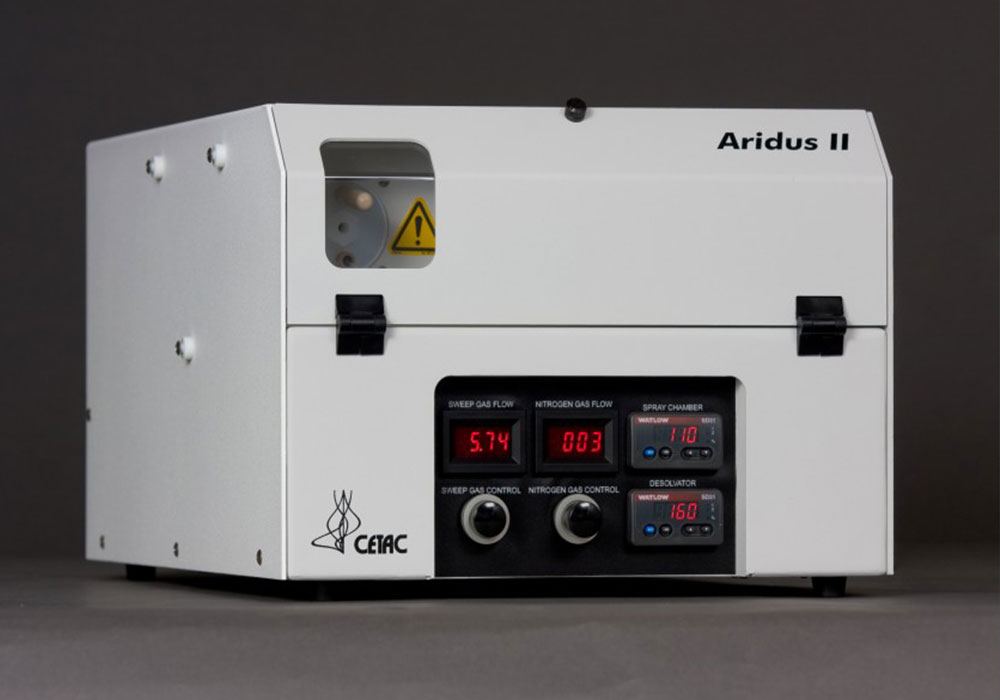
Piezoelectric atomisation, not a gas stream.
Rather than using a gas stream to create aerosol (conventional pneumatic nebulization), these instruments pass the liquid over a piezoelectric transducer vibrating at approximately 1 MHz, atomising the sample far more efficiently.
A conventional nebulizer delivers approximately 1–2% of the sample to the plasma; the rest drains to waste. An ultrasonic nebulizer delivers 20–30%. More analyte reaching the plasma means a proportionally stronger signal.
Delivering more sample also delivers more solvent to the plasma. Excess solvent cools the plasma, destabilises it and creates polyatomic interferences (ArO⁺, ClO⁺, ArCl⁺ and others appearing at the same mass as real analytes). The U5000AT+ includes an integrated desolvation system — a Peltier-cooled condenser — that removes solvent vapour after the nebulizer while dried analyte particles pass through to the plasma.
The commercial case: transfer work from GFAA to ICP-OES. Graphite furnace atomic absorption reaches very low detection limits but measures one element at a time, taking several minutes per element per sample. ICP-OES measures 30–70 elements simultaneously in about a minute but traditionally cannot reach GFAA's detection limits for the most difficult matrices. An ultrasonic nebulizer closes that gap — a laboratory that can move trace metal work off GFAA onto ICP-OES multiplies throughput without buying a new spectrometer.
Sub-ppt PGE, REE and actinide detection.
Sub-ppt platinum group element determination is a defining analytical challenge for South Africa's platinum, precious-metals and rare-earth sectors and their contract laboratories, and for actinide work at national nuclear research facilities — the primary South African application for this instrument.
A clean module in under five minutes.
All wetted parts are contained in a user-removable nebulizer/desolvation module. A second module can be swapped in under five minutes to eliminate memory effects and simplify cleaning between samples or matrices.
The rest of the Teledyne CETAC sample introduction range.
Membrane desolvator, alongside the Marin-5 and DS-5 systems.
Cold vapor / hydride generation for As, Se, Sb, Bi, Te and Hg.
Also available: OmniPure sub-boiling acid distillation · C-Flow, CEI-100, QuickWash accessories · SPR-IDA chelation/preconcentration reagent.
Where sub-ppt detection matters.
Reach detection limits GFAA can't scale to
Talk to our applications team about matching a nebulizer and desolvation configuration to your matrix.
Where the Ultrasonic Nebulizers is put to work.
Questions we are asked about the Ultrasonic Nebulizers.
A conventional pneumatic nebulizer delivers approximately 1–2% of the sample to the plasma; the rest drains to waste. By atomising the sample with a piezoelectric transducer instead of a gas stream, an ultrasonic nebulizer delivers 20–30%. More analyte reaching the plasma means a proportionally stronger signal — documented as a 5–25× detection limit improvement on ICP-OES, depending on the analyte.
Delivering more sample also delivers more solvent to the plasma. Excess solvent cools the plasma, destabilises it and creates polyatomic interferences that appear at the same mass as real analytes. The integrated Peltier-cooled condenser removes solvent vapour after the nebulizer, so only dried analyte particles reach the plasma.
GFAA reaches very low detection limits but measures one element at a time, taking several minutes per element per sample. ICP-OES measures 30–70 elements simultaneously in about a minute but traditionally cannot match GFAA's detection limits on the most difficult matrices. An ultrasonic nebulizer closes that gap, letting a laboratory move trace metal work off GFAA onto ICP-OES and multiply throughput without buying a new spectrometer.
All wetted parts are contained in a user-removable nebulizer/desolvation module. A second module can be swapped in under five minutes to eliminate memory effects, rather than cleaning the installed module in place between matrices.
The workflow around the Ultrasonic Nebulizers.
Autosamplers & Automation
Unattended sample delivery from micro-volume to extended-rack high-throughput — standard, flowing-rinse, stirring and rapid-introduction configurations.
View product →ICP & ICP-MS Consumables
The highest-value content on the site: every ICP in South Africa, regardless of manufacturer, consumes torches, nebulizers, spray chambers and injectors — and MAD can supply them locally, for any brand.
View product →MICAP-OES 1000
Simultaneous multi-element determination in prepared solutions — without argon, without a chiller, at a fraction of conventional ICP-OES running cost.
View product →